- Watered all new plantings
- Removed Johnson grass
- Mowed trail and access to feeding area
- Relocated 7 Leopard frogs from pond near house to river
- Saw black snake with yellow stripe down the length of its back
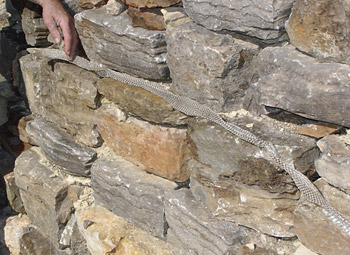
- Found snake skin
Posted in
2007 Journal, Census, Habitat
Planted all plants and added 2 small packages of hummer and singer mix with Natural Gardener's Hill Country Garden Mix throughout.
Posted in
2007 Journal, Habitat
- Saw raccoon
- Armadillo
- Heard turkeys
Added more herbs
- 3 Lavender
- 1 Rosemary
- 1 Thyme
New plants from the Lady Bird Johnson Wildflower Center plant sale
- 2 Bushy skullcap
- Cenizo
- Sensitive pink mimosa
- Yellow bells (Esperanza)
- 2 Flame acanthas
- Rose mallow
- 4 Blue mistflower
- Gregg mistflower
- Snakeroot
- Evergreen sumac
- Canyon mock orange
- Damianta
- Salvia greggi
Posted in
2007 Journal, Census, Habitat
Found a mother scorpion hiding in a concrete block, under a log with the babies living on her back.
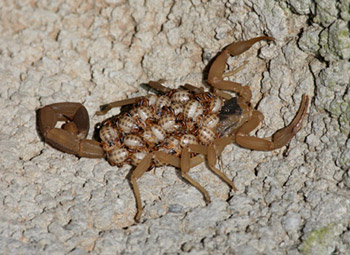
Caretaker's note: The Striped Bark Scorpion is so named because it is often found hiding in dark, cool places under dead vegetation, fallen logs, under rocks, under boards and debris. Scorpions are non-insect arthropods and typically nocturnal. This species is common in Texas. The sting can be painful, but never lethal.
The young climb on the mothers back soon after birth and molt. The young may molt as many as six times before maturity. Scorpions have a keen sense of touch and smell. They sense the movement of it's prey through chemical receptor organs on the underside as they walk. They are beneficial to humans by reducing local insect populations including crickets, flies, beetles and other small insects.
- Removed KR and Johnson grass
- 2 new Lavender
- Plan for short grasses and low growing ground covers next to house on north side
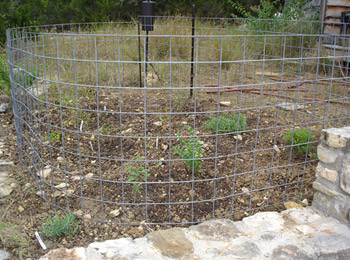
- Created new planting area for diversity near house
Posted in
2007 Journal, Census, Habitat
Edge effect on warblers are harmful with increase in cowbird predation, cats, jays
- Millet brought cowbirds. No more millet
Caretaker's note: An edge is a boundary between a grassland and a woodland. An edge effect occurs when one species predates on another within the edge. For example, predatory species (feral cats, cowbirds, fire ants) will move into the edge of the woodland up to a 100 yards or more. watersto_jennystone's goal in reducing edge effects is to maintain a contiguous dense canopy that is undisturbed with trails or excessive clearing.
Neighbor running chainsaws all day for Ashe juniper removal
Caretaker's note: It is popular for landowners in the Texas Hill Country to remove Ashe juniper. This tree is locally called a "cedar". Myths abound about this much maligned native species. Some believe that the Ashe juniper steals water from other nearby trees and plants. In fact, all trees and plants compete for limited ground water resources. The Ashe juniper is beneficial for many wildlife species: for food, cover and shelter. Poor land management practices over many generations, like overgrazing, have allowed this species to thrive and become aggressive.
The Ashe juniper is a first succession plant, that can grow where almost nothing else can in poor conditions. The thin leaves drop to form soil. Ashe juniper should be managed, but not totally eradicated. This tree is critical to the survival of the endangered Golden-cheeked warbler who uses strips of the easily peeled bark to build its nest. Diversity is a useful goal in any wildlife area and Ashe juniper should never be totally removed. See: Untwisting the Cedar: The myths and culture of the Ashe Juniper tree for more information.
Posted in
2007 Journal, Habitat, Predator
